JOHN

[‘John Strange Winter’ [Henrietta E. V. Stannard], English novelist and magazine editor.] Autograph Note Signed both in nom de plume and real name to Norman Wetton, in response to a request for an autograph.

Author: 
‘John Strange Winter’ [Henrietta Eliza Vaughan Stannard, née Palmer] (1856-1911), English novelist and magazine editor
Publication details: 
24 August 1905, on postcard with stamp and Kensington [London] postmark.
£25.00

On 14 x 9 cm plain printed postcard, addressed (by the recipient) to ‘Norman Wetton / 7 Claremont Road / Forest Gate / Essex’. On the plain side of the card she writes: ‘With pleasure here is the sign-manual of your’s [sic] faithfully / John Strange Winter. / (Henrietta. E. V. Stannard.) / Aug 24. 1905 -’.

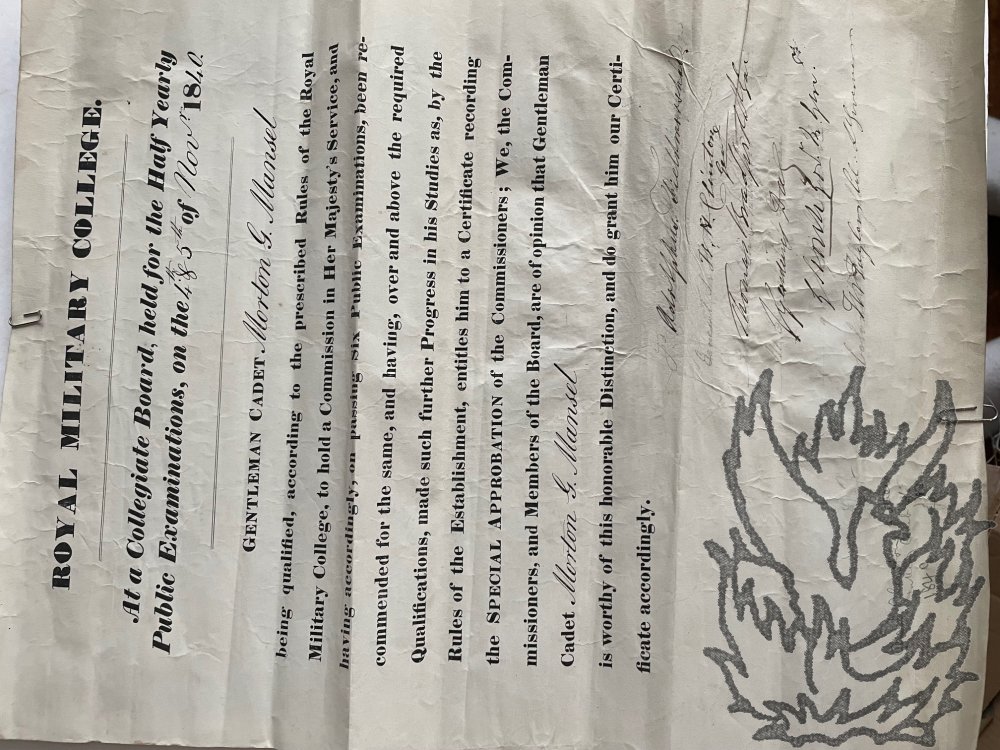
[Royal Military College, Sandhurst, 1840.] Certificate of Morton Grove Mansel, signed by Sir George Scovell, Gov.; Thomas William Taylor, Lt Gov.; Adolphus, Duke of Cambridge; Sir Thomas Bradford; Sir William Henry Clinton; Sir John Gardiner.

Author: 
Sandhurst, Royal Military College; Sir George Scovell, Gov.; Thomas William Taylor, Lt Gov.; Adolphus, Duke of Cambridge; Sir Thomas Bradford; Sir William Henry Clinton; Sir John Gardiner
Sandhurst
Publication details: 
'At a Collegiate Board, held for the Half Yearly Public Examinations, on the 4th. & 5th of Novr. 1840.' [Royal Military College, Sandhurst.]
£280.00
Sandhurst

A large, attractive printed certificate, somewhat in the style of an early Victorian public notice, with heavily leaded font. Printed in black on one side of a 32 x 41 cm piece of cream vellum paper. Discoloured and ruckled from having been rolled up, but in good overall condition, and highly suitable (once flattened out) for framing. At bottom left, signatures of six ‘Commissioners, and Members of the Board’, one above the other: ‘Adolphus Fieldmarshal / W. H. Clinton / Thomas Bradford A Gnl / J Gardiner DAG / G Scovell Govr. M. Genl. / T W Taylor Col: Lt Governor’.

[San Juan Island, Washington State.] Printed paper: 'Correspondence respecting the Island of San Juan. Presented to both Houses of Parliament by Command of Her Majesty. 1860.'

Author: 
San Juan Island, Washington State; Lord John Russell; Lord Lyons; General Lewis Cass; Captain Pickett; Captain Bazalgette; Assistant-General Pleasonton
Publication details: 
'Presented to both Houses of Parliament by Command of Her Majesty. 1860.' and 'London: Printed by Harrison and Sons.'
£45.00

The correspondence concerns the need to prevent a 'collision between the American and British authorities on the island' (the American General Harney is quoted as saying that 'he is satisfied that any attempt of the British Commander to ignore this right of the territory will be followed by deplorable results out of his power to control'). [2] + 4 + [1]pp, foolscap 8vo. Stabbed as issued. On discoloured and worn paper, with slight chipping at head of first leaf. Last page (back cover) printed crosswise in the customary fashion (for folding into a packet).

[Scottish peer who planted millions of trees: John Murray, 4th Duke of Atholl.] Autograph Letter Signed to ‘Captn Ross [Rayley?] R. N.’, apparently regarding the sale and transportation of timber.

Author: 
John Murray (1755-1830), 4th Duke of Atholl, Scottish peer who planted millions of trees by firing seeds from cannon
Publication details: 
‘Dunkeld [Perthshire, Scotland] Novr: 3d 1828’.
£80.00

3pp, 12mo. Bifolium. Thirty-six lines of text, signed ‘Atholl’. Text complete (except for address of recipient), on grubby and worn paper. Folded three times. The letter has been trimmed at the foot, resulting in some loss to the address of the recipient, which appears to read ‘Captn Ross R. N. / 160 New Bond Street’. This is presumably the ‘Rayley, [sic] Captain, R.N. 160, Bond-street’, who in 1832 was listed among the proprietors of shares in London University. The Duke’s handwriting is execrable.

[?Ulster Scot? [Rev. J. C. F. Hood, Deputy Assistant Chaplain-General to the Forces.]] Newspaper cutting of letter to The Times from Hood, with Manuscript Letter from ?Ulster Scot? thanking him, and note [from W. Vance Packman] disputing facts.

Author: 
?Ulster Scot? [Rev. John Charles Fulton Hood (1884-1964), Deputy Assistant Chaplain-General to the Forces, husband of harpist Helen Patuffa Kennedy-Fraser; W. Vance Packman]
Publication details: 
Letter (Postmark: Belfast) dated 30 October 1929. Newspaper cutting of Hood's letter to The Times dated 28 October 1929. Undated anonymous note from 19 Sutton Court Road, Chiswick, London.
£150.00

Hood was married to the harpist Helen Patuffa Kennedy-Fraser (1889-1967), daughter of Marjory Kennedy-Fraser (1857-1930), the celebrated collector and singer of Hebridean songs. The two items are in good condition, lightly aged. ONE: Manuscript Letter Signed by 'Ulster Scot.' 1p, 8vo. Begins: ?Dear Rev Sir / Glad to see you took up the cudgels on behalf of the Ulster Scot.The writer of the letter considers that the part played by this group in building industry &c. was surpassed by their efforts in cristainising [sic] and civilising the nations of the world.

[Lord Simon [John Allsebrook Simon, 1st Viscount Simon], Chancellor of the Exchequer and Lord Chancellor.] Autograph Letter Signed to Joyce, daughter of Sir Courtenay Ilbert, regarding arrangements for her wedding.

Author: 
Lord Simon [John Allsebrook Simon, 1st Viscount Simon] (1873-1954), Liberal Home Secretary, Foreign Secretary, Chancellor of the Exchequer, Lord Chancellor [Sir Courtenay Ilbert, Clerk of the Commons]
Publication details: 
4 June 1912. On letterhead of 'Headquarters: / The London Scottish, / 59, Buckingham Gate, / London, S.W.' [During the British enquiry into the Titanic sinking, at this venue.]
£35.00

A tenuous Titanic item: at the time of writing Simon, as solicitor-general, was representing the Board of Trade at the British enquiry into the sinking, at the address on the letterhead. See his entry and Ilbert's in the Oxford DNB. Joyce Violet Ilbert (1890-1957) was the youngest of Sir Courtenay's five daughters. 3pp, 12mo. On bifolium. In good condition, lightly aged and worn. Folded twice. Written in pencil. Signed ‘John Ilbert’.

[Lord Canning [Charles John Canning, Earl Canning], Governor-General and first Viceroy of India.] Autograph Letter Signed to Lord Fitzgerald, as Under-Secretary to Lord Aberdeen at the Foreign Office, concerning Baron Brunow.

Author: 
Lord Canning [Charles John Canning, Earl Canning (1812-1862)], Governor-General and first Viceroy of India [Lord Fitzgerald [William Vesey Fitzgerald (1783-1843)], Anglo-Irish politician]
Publication details: 
'F. O. [Foreign Office, Whitehall] Nov 11. 41 [1841]'.
£120.00

Showing signs of the early stirrings of the Great Game. See Canning's entry, and that of Fitzgerald, in the Oxford DNB. At the time of the letter Canning was serving in his first governmental appointment, as Under-Secretary to Lord Aberdeen in the Foreign Office, in Peel’s administration, while Fitzgerald was President of the Board of Control. The ‘Baron Brunow’ referred to in the letter is Russian Ambassador in London, Philipp Graf von Brunnow (1797-1895). 2pp, 12mo. On first leaf of a bifolium. Docketed on second leaf, ‘Lord Canning / respecting Baron Brunow Novr 11/41’.

[John Adams-Acton, English sculptor.] Letter in a Secretarial Hand, Signed by him, inviting the editor of Punch Tom Taylor to visit his studio, with a list of six works to be seen there, including a bust of the prime minister Gladstone.

Author: 
John Adams-Acton (1830-1910), English sculptor [Tom Taylor (1817-1880), playwright and editor of Punch]
Publication details: 
‘Margutta House. / 103. Marylebone Road / March 28th. 1873.’
£56.00

See his entry, and that of Taylor, in the Oxford DNB. 3pp, 12mo. On bifolium. In fair condition, lightly aged. Folded twice. Only the sculptors heavily inked signature ‘John Adams-Acton’ is in his hand, the rest more lightly written by an amanuensis. Addressed ‘To, Tom Taylor Esqr.’ Begins: ‘I address you as a representative of the press to solicit you to pay my studio a visit.’ He lists the names of five ‘public and distinguished men’ whose busts he can show, beginning with ‘The Right Honble W. E. Gladstone - Premier’ and including ‘Isaac Holden Esqr.

[Sir John Betjeman, poet laureate.] Typed Letter Signed from Elizabeth Moore (‘Dorinda’), ‘Secretary to Sir John’, telling Paul Furness that he cannot help in his 'researches into pubs with connections with the Socialist movement’ due to ill health.

Author: 
[Sir John Betjeman (1906-1984), poet laureate] Elizabeth Moore (‘Dorinda’), ‘Secretary to Sir John’
Publication details: 
15 February 1982. 29 Radnor Walk, London, SW3.
£25.00

Betjeman’s daughter Candida Lycett Green, in her edition of her father’s later letters, refers to Moore as the his ‘gentle secretary’, ‘whom he always called “Dorinda,” and who lived on the other side of the street’. She also states that after his stroke in 1981, the poet could no longer sign his name, and dictated letters to Moore. 1p, foolscap 12mo. In good condition, lightly aged and creased. Folded once for postage. On his letterhead (‘Sir John Betjeman’ at top left, and address at top right) printed in brown ink on cream paper. Addressed to ‘Mr. Furness’.

[Sir John Taylor Coleridge, judge and editor of the Quarterly Review.] Autograph Letter Signed to Sir John Wither Awdry, asking for clarification. On reverse of part of letter from the Lord Chancellor Lord Cranworth.

Author: 
Sir John Taylor Coleridge (1790-1876), judge and editor of the Quarterly Review [Robert Monsey Rolfe, Lord Cranworth (1790-1868), twice Lord Chancellor; Sir John Wither Awdry (1795-1878), judge]
Publication details: 
'April. 19. 1855 / P[rivy]. C[ouncil].'
£56.00

Coleridge was the nephew of the poet Samuel Taylor Coleridge. See his entry, and that of Cranworth, in the Oxford DNB. The letter relates to Palmerston’s first ministry. 1p, 16mo (cut down to a 12 x 10 cm piece of wove paper). In fair condition, lightly aged and discoloured, with traces of glue from mount adhering to one edge of blank reverse. Signing himself ‘J. T C’, Coleridge writes: ‘My dear Awdry / I have been with the Chancellor in consequence of the above - & promised to send him a minute in writing - where we have had trouble. Can you help me with your recollection. / In haste.

[Lord Moulton [John Fletcher Moulton], mathematician, Liberal politician and Cambridge Apostle.] Autograph Letter Signed, thanking ‘Mrs Earle’ for one of the letters which have 'given me most pleasure in my life’.

Author: 
Lord Moulton [John Fletcher Moulton, Baron Moulton (1844-1921)], mathematician, judge, Liberal politician and Cambridge Apostle
Publication details: 
24 May 1894. Deleted and thus indecipherable ‘S.W.’ London address.
£45.00

See his entry in the Oxford DNB. 2pp, 12mo. In good condition, lightly aged and worn. Signed ‘J Fletcher Moulton’. Begins: ‘Dear Mrs Earle / Just at the worst moment of the fight your inspiring letter came to cheer me.’ He hopes he will be deserving of the ‘kind things’ she writes: ‘I could truthfully say things at least as kind in return but I fear my epistolary style does not lend itself thereto so I shall trust that you will take these as said.’ He ends by saying that he will retain the letter ‘as one of those which has [sic] given me most pleasure in my life’.

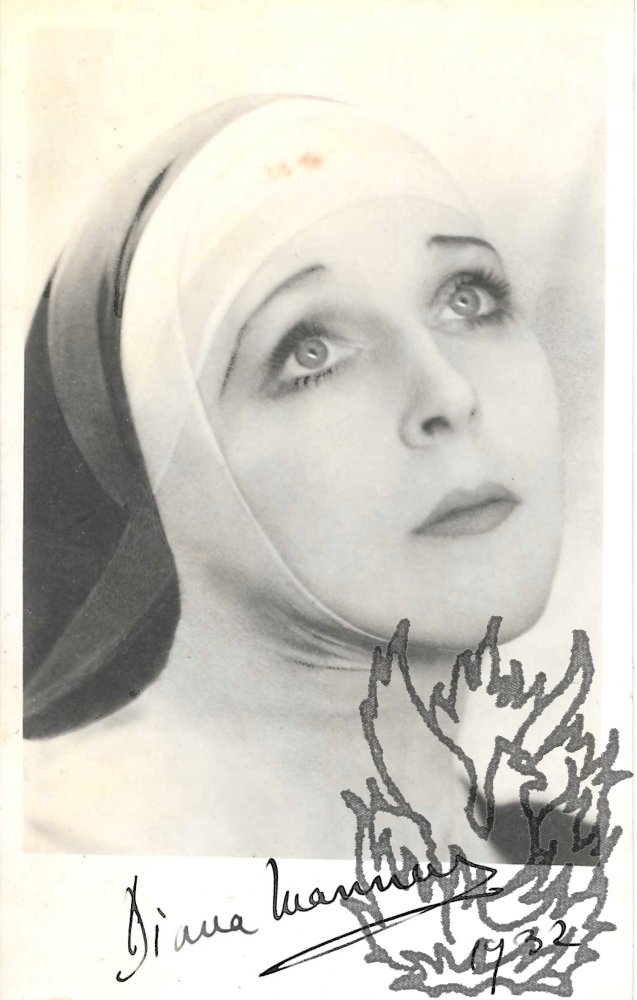
[Lady Diana Cooper, English society beauty, actress and memoirist.] Autograph Signature on publicity photograph of her dressed as a nun, from the play 'The Miracle'.

Author: 
Lady Diana Cooper [née Lady Diana Olivia Winifred Maud Manners, later, as wife of Duff Cooper, Viscountess Norwich] (1892-1986), English society beauty, actress and memoirist
Diana
Publication details: 
1932. No place.
£45.00
Diana

See her entry in the Oxford DNB, which describes how she accepted Max Reinhardt's offer ‘to play the Madonna in a mime play, The Miracle. This was first staged in the USA from November 1923 to the following May, and again for the following three autumns and winters. It toured Europe in 1927, and London and the provinces in 1932; the last performance was in January 1933.

[W. G. Wills [William Gorman Wills], Irish playwright and painter.] Autograph Letter Signed to Tom Taylor, fellow-playwright and ‘Punch’ editor, recommending Walter John Knewstub, Dante Gabriel Rossetti’s assistant.

Author: 
W. G. Wills [William Gorman Wills (1828-1891)], Irish playwright and painter [Tom Taylor (1817-1880), playwright, Punch editor; Walter John Knewstub (1831-1906), assistant to Dante Gabriel Rossetti]
Publication details: 
‘76 Fulham Rd / Brompton [London] / May 4 - 77 [1877]’.
£56.00

See his entry and Taylor’s in the Oxford DNB. 1p, 12mo. Sixteen lines of closely-written text. In good condition, lightly aged. Folded once. Begins: ‘My dear Mr. Taylor / Would you allow me to introduce a friend of mine Mr. Knewstube to you.

[Sir Frederick Lugard, Governor of Hong Kong, Governor-General of Nigeria.] Autograph Letter Signed to Sir Edwin Arnold, having promoted the interests of Arnold’s recommendation, and with generous references to him.

Author: 
Sir Frederick Lugard [Frederick John Dealtry Lugard, 1st Baron Lugard; Lord Lugard] (1858-1945), Governor of Hong Kong, first Governor-General of Nigeria [Sir Edwin Arnold, author of 'Light of Asia']
Publication details: 
1 August 1903. On letterhead of the Junior Army & Navy Club, St James’s Street, S.W. [London]
£120.00

See the two men’s entries in the Oxford DNB. 3pp, 12mo, with last page written crosswise. On bifolium. In good condition, lightly aged. Folded once. Addressed to ‘Dear Sir Edwin’ and signed ‘F D Lugard’. He regrets to inform him that there is ‘no present vacancy in Northern Nigeria’, but that he has ‘written to the c.o. on behalf of Mr Trayler whom you recommend, & I hope he may obtain an appointment in another Colony if no vacancy occurs in N. Nigeria’.

[Sir John Graham Dalyell, Scottish antiquary and naturalist.] Autograph Letter Signed undertaking to promote the recipients' ‘views & interests’.

Author: 
Sir John Graham Dalyell (1775-1851), Scottish antiquary and naturalist
Publication details: 
‘H[?] Street 17 Nov 1820’.
£56.00

See his entry in the Oxford DNB. 1p, 4to. In his expansive hand, with a good bold signature. On worn and aged leaf of laid paper, with two small punch holes to inner edge, affecting one word of text. Reads: ‘Dear Sirs / I feel quite at a loss to express my sense of this mark of your attention. I can only assure you that my best exertions shall not be wanting to promote your views & interests. / Meantime / I am Dear Sirs / Yours faithfully / John Graham Dalyell’.

[John Goss, Communist baritone.] Autograph Signature on part of printed page from programme.

Author: 
John Goss (1894-1953), Communist baritone singer associated with Peter Warlock and Frederick Delius
Publication details: 
No date or place.
£23.00

See his entry in Grove’s. A good large firm signature, 'John Goss'. On irregularly-shaped piece of laid paper cut from a printed programme, a 9.5 x 8 cm rectangle with one large triangle cut from a corner. Written over part of the words to the song 'I am a brisk and sprightly lad'. The printing on the back headed ' Once I loved a maiden fair Anon., 1600 / I am a brisk and sprightly lad Anon., 1750 / MR. JOHN GOSS.'

[John Walter the younger, proprietor of The Times.] Autograph Letter Signed to Tom Taylor, editor of Punch, regarding the Arundel Society, and a ‘wonderful’ chromolithograph of a Van Eyck.

Author: 
John Walter (1818-1894) the younger, proprietor of The Times [Tom Taylor (1817-1880), playwright, editor of Punch]
Publication details: 
20 February 1873. On letterhead of 40 Upper Grosvenor Street [London].
£56.00

See the two men’s entries in the Oxford DNB. 2pp, 12mo. On first leaf of bifolium. In good condition, lightly aged and worn. Folded once. From Taylor’s papers. Addressed to ‘Tom Taylor Esq’. Begins: ‘Dear Mr Taylor / I have profited by your kind instructions, & enrolled myself on the List of the Arundel Society.’ He finds the collection ‘well worth seeing’, and ‘the Van Eyck in particular strikes me as being the most wonderful example of successful reproduction in Chromo Lithography that I have yet seen’. Signed ‘J Walter’. From Taylor’s papers.

[Lord Carnarvon: Henry Herbert, 3rd Earl of Carnarvon.] Autograph Letter in the Third Person, thanking Mrs Page for papers on the boundaries of Highclere, and commiserating with her on the death of Colonel Page.

Author: 
Lord Carnarvon [Henry John George Herbert, 3rd Earl of Carnarvon (1800-1849)], English nobleman, Tory politician and traveller, owner of Highclere Castle, Hampshire [Colonel Page]
Publication details: 
‘43. Grosvenor Sq / July 2. 1835.’ [London]
£56.00

See his entry in the Oxford DNB. 2pp, 4to. In fair condition, on lightly aged and worn paper. Folded four times. Begins: ‘Lord Carnarvon presents his Compliments to Mrs. Page and is extremely obliged by her polite attention in sending him the Papers relating to the boundaries of Highclere - Burghclere, and Woodhay Parishes, which he has no doubt will prove extremely useful to him’. He has ‘many apologies to make for not sooner acknowledging the receipt of the Papers, but he has been for some time past incessantly occupied in attending the Committee on the Gt.

[Liverpool concerts for ‘Spain Relief’, 1939: John Goss, Communist baritone.] Two Typed Letters Signed to ‘Mr. Cameron’ and one Typed Card Signed to ‘Miss Cameron’, on behalf of the Musician’s Group of the Left Book Club.

Author: 
John Goss (1894-1953), Communist baritone associated with Peter Warlock and Frederick Delius [Spanish Civil War; Left Book Club; Liverpool]
Publication details: 
The letters to ‘Mr. Cameron’ dated 21 December 1938 and 9 January 1939; both from 35a Woburn Square, WC1 [London]. The card undated [early 1939], with London postmark.
£120.00

See his entry in Grove’s. Each with his firm signature 'John Goss'. The two letters in fair condition, on aged and creased paper, folded for postage, the first of the two with a short closed tear to one edge. The card in good condition, lightly aged. ONE: TLS to ‘Mr. Cameron’, 21 December 1938. 1p, 4to. Cameron’s letter ‘to the convener of the Musician’s Group of the Left Book Club’ has been passed to him.

[General Sir J.G. Maxwell, Commander-in-Chief in Ireland during the 1916 Easter Rising.] Autograph Letter Signed to 'Mr. Peverley Dodd', with regard to the etiquette for an engagement in Malta by the Duke of Connaught.

Author: 
General Sir John Grenfell Maxwell (1859-1929) British Army officer, Commander-in-Chief in Ireland during 1916 Easter Rising and its aftermath [Rev. Henry Peverley Dodd (1875-1938), army chaplain]
Publication details: 
‘The Palace / Malta / March 24.’ [1908] On letterhead of the High Commissioner, Mediterranean.
£220.00

The context of the letter is explained in Maxwell’s entry in the Oxford DNB: ‘In the autumn of 1902 Maxwell was chosen by the duke of Connaught, then acting commander-in-chief in Ireland, as his chief staff officer at Dublin. There he remained until May 1904, when Connaught became inspector-general of the forces, and Maxwell followed him to London.

[James Taylor, banker and writer on finance.] Autograph Letter Signed to R. S. MacKenzie of Chesterfield, regarding a magazine article, a report, plans for his return to London, and pamphlets he is sending.

Author: 
James Taylor (1788-1863), banker and writer on finance, senior partner in the banking firm James Taylor & Co, brother of John Taylor (1781-1864), London publisher with firm Taylor & Hessey
Publication details: 
‘Bakewell [Derbyshire] Nov 5. 1832’.
£65.00

Taylor is noticed in his brother’s entry in the Oxford DNB. 2pp, 12mo. On first leaf of bifolium, the second leaf carrying the address (‘R. S. MacKenzie Esqr / Chesterfield’), and a seal in black wax, beneath which is a corner of the leaf, cut away in opening the letter, the leaf also being annotated ‘James Taylor of Bakewell / author of “What is Money?”. In good condition, lightly aged, with thin strip of brown paper mount along inner edge of second leaf. Good signature, with expansive flourish, ‘Jas Taylor’.

[Charlotte Bronte ‘did not always tell the truth’ and guilty of ‘deceit’.] Copy of Typed Letter to E. F. Benson [from her editor John Alexander Symington], criticising her, with reference to C. W. Hatfield and T. J. Wise.

Author: 
[Charlotte Bronte; John Alexander Symington (1887-1961), literary editor; E. F. Benson [Edward Frederic Benson] (1867-1940); Thomas James Wise (1859-1837), book collector and forger; C. W. Hatfield]
Publication details: 
25 April 1932.
£450.00

See the various entries in the Oxford DNB. Typed carbon copy. 1p, foolscap 8vo. Text complete, on aged piece of carbon paper, worn and chipped at edges. No signature. Addressed at foot to ‘E. F. Benson Esq.’ Thirty-one lines of text. He begins by stating that Benson, in his ‘work on Charlotte Brontë’, has ‘made a very correct study of her’. After discussing a point about Branwell Bronte, he states: ‘We cannot rely on Charlotte’s assertion that he knew nothing whatever of their ventures in publishing.

[St John Ervine [pseudonym of John Greer Irvine], Ulster playwright and novelist.] Typed Letter Signed to Miss Esther Boyer, declining to respond to a 'cub reporter'.

Author: 
St John Ervine [pseudonym of John Greer Irvine (1883-1971)], Ulster playwright and novelist
Publication details: 
21 December 1938. On letterhead of Honey Ditches, Seaton, Devon.
£56.00

See his entry in the Oxford DNB. 1p, 12mo. On worn and aged paper, with L-shaped closed tear at left-hand edge. Folded for postage. Addressed to her at Bebington in the Wirral. Loose, smudged signature ‘St John Ervine’. He thanks her for her ‘letter and its enclosure, which I return. If I were to rebuke every cub reporter who wrote so stupidly as the young man to whom you refer, I should fill The Observer with my reproofs, apart altogether from the fact, that I should be giving the young man an exaggerated sense of his importance.

[Lord FitzHardinge, admiral and Member of Parliament.] Autograph Letter Signed to W. G. Romaine of the Admiralty, with regard to a petition brought by the shipbuilder John Clare.

Author: 
Lord FitzHardinge [Maurice Frederick FitzHardinge Berkeley] (1788-1867), Royal Navy admiral, and Whig Member of Parliament [William Govett Romaine (1815-93) of the Admiralty; John Clare, shipbuilder]
Publication details: 
17 January [no year, on paper watermarked ‘JOYNSON | 1860’]; on Berkeley Castle letterhead.
£120.00

See the two men’s entries in the Oxford DNB. For the context, see the 1863 pamphlet ‘Clare versus the Queen’, in the slug to which John Clare (1820-1885) is described as ‘THE KING OF METAL SHIP BUILDERS’. 3pp, 12mo. Bifolium. In fair condition, lightly aged and worn, with folds. Docketed ‘Fitzhardinge / Lord -’. Signed ‘Fitzhardinge’ (sic). In a difficult hand.

[John Murray IV, London publisher.] Autograph Letter Signed from 'John Murray junr.' to Colonel Fellows, regarding the difficult rebinding of his leather volumes.

Author: 
John Murray IV (1851-1928), notable London publisher
Publication details: 
2 April 1910. Letterhead of 50 Albemarles Street, W. [London]
£80.00

See the entry on the Murray family in the Oxford DNB. In fair condition lightly aged and worn. Folded for postage, with short closed tears to the edges of central horizontal fold. Small biographical slip laid down at top left. Addressed to ‘Dear Colonel Fellows’ and signed ‘John Murray junr.’ Reads: ‘Our binders have done the best they can with your Volumes, short of rebinding, but as you know patching up leather bindings in a really satisfactory way is not easy. / However, I hope that you will be satisfied with the volumes which I am sending on to you today.’

[C. M. Ingleby, Shakespeare scholar who unmasked John Payne Collier.] Autograph Letter Signed, ordering a work he doesn’t ‘actually want’ from a bookseller’s catalogue.

Author: 
C. M. Ingleby [Clement Mansfield Ingleby (1823-1886), Shakespeare scholar who unmasked John Payne Collier as a forger
Publication details: 
‘Valentines / Ilford. / Novr. 19. ’73 [1873] Essex’.
£45.00

See his entry, and that of Collier, in the Oxford DNB. 1p, 12mo. In fair condition, on worn and spotted paper. Folded twice for postage. The recipient is not named. Addressed to ‘Dear Sir’ and signed ‘C. M. Ingleby’. He offers ten pounds for ‘yr. copy of the Encycl: Metropolitana’, and will pay the carriage if he sends it. ‘I don’t actually want it: but its a good book, & I’ll give that as an investment.’ He will send a cheque, once he receives ‘a Post Card: with “yes” on it’. Ends: ‘Other matters in yr. excellent Catalogue I postpone.’

[Stanley J. Weyman, popular English novelist of the ?cloak and dagger school?.] Autograph Letter Signed to 'Miss Barron' [i.e. Rosemary Barron]

Author: 
Stanley J. Weyman [Stanley John Weyman] (1855-1928), popular English Victorian and Edwardian novelist of historical romance and the 'cloak and dagger school'
Publication details: 
7 March 1926. On letterhead of Plas Llanrhydd, Ruthin, North Wales.
£50.00

Weyman was, as his entry in the Oxford DNB states, ?one of the most popular and skilled of the historical romance novelists of the cloak and dagger school?. Oscar Wilde recommended (in all seriousness) Weyman's novels as reading for convicts. 1p, 16mo. In fair condition, lightly creased and worn. Folded for postage. From the collection of Rosemary Barron, autograph collector. Reads: 'Dear Miss Barron / I am sorry that your letter has remained unanswered so long but I have been laid aside by illness.

[The man who built Cardiff: John Crichton-Stuart, 2nd Marquis of Bute.] Autograph Letter Signed, explaining restrictions he is placing on the recipient's permission to shoot on his land.

Author: 
The man who built Cardiff: John Crichton-Stuart, 2nd Marquis of Bute (1793-1848), styled Lord Mount Stuart between 1794 and 1814, Scottish aristocrat and industrialist
Publication details: 
?Mountstuart [Mount Stuart House, Isle of Bute] 21st Septr 1820?.
£60.00

See his entry in the Oxford DNB. 2pp, 12mo. In fair condition, on lightly aged and spotted paper. Folded for postage. The recipient is not named. Signed ?Bute and Dumfries.? ?I should with pleasure have renewed to you a general permission to shoot upon my lands in Galloway, but having this year restricted other gentlemen in the neighbourhood on account of the condition of my muirs, [sic] I feel myself under the necessity of confining my permission to you within those which [match?] immediately with Mr Adair?s.?

St John Hankin [St. John Emile Clavering Hankin, Edwardian ?New Drama? playwright.] Two Autograph Letter Signed to actor-manager Otho Stuart, one asking to read him a ?new play?, the other asking for the return of a script.

Author: 
St John Hankin [St. John Emile Clavering Hankin (1869-1909)], Edwardian playwright and essayist, follower of Bernard Shaw and exponent of the ?New Drama? [Otho Stuart (1863-1930), actor-manage]
Publication details: 
ONE: 2 November 1906; on letterhead of the Savile Club, 107 Piccadilly, W. [London] TWO: 2 February 1908; 30 Brechin Place, S.W. [London]
£80.00

See his entry in the Oxford DNB. Stuart was at the time actor-manager of the Adelphi Theatre, London. Both items in good condition, lightly aged, and folded for postage. ONE: 3pp, 12mo (the third page carrying a postscript written lengthwise). Bifolium. Begins: ?Dear Sir / I have a new play which I should like to read to you if you would care to hear it.

St John Hankin [St. John Emile Clavering Hankin, Edwardian ?New Drama? playwright.] Autograph Letter Signed to Alexander Louis Teixeira de Mattos

Author: 
St John Hankin [St. John Emile Clavering Hankin (1869-1909)], Edwardian playwright, follower of Bernard Shaw and exponent of ?New Drama? [Alexander Louis Teixeira de Mattos (1865-1921). See Wikipedia]
Publication details: 
10 June [1897]; from Stratford-on-Avon, on cancelled letterhead of 11 Addison Road, Bedford Park [London].
£75.00

See his entry in the Oxford DNB. 2pp, 12mo. Bifolium. In fair condition, on aged and worn paper, with rusting from a paperclip to both leaves. Addressed to 'Mr Texeira [sic] de Mattos' and signed 'S John E. C. Hankin'. He thanks him for the cheque and is sorry to hear that the recipient's 'great project has come to nought - at least for the moment'. He expects that de Mattos saw 'the Bankruptcy of the New Saturday duly chronicled? You were a true prophet. I gather it will pay nothing in the ?'. The New Saturday was a short-lived newspaper, going to the wall after a few issues in 1897.

Syndicate content