COLMAN

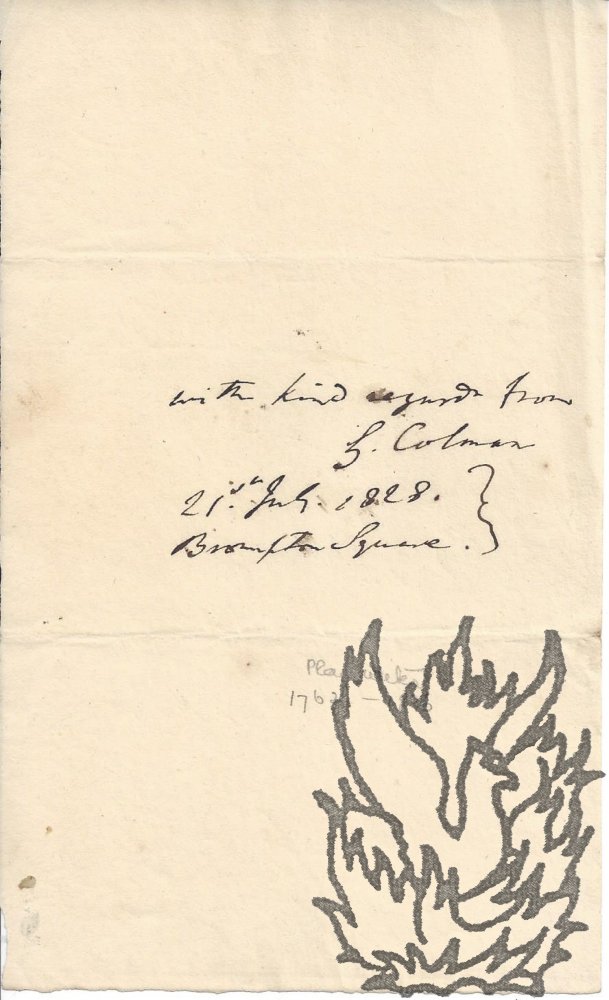
[George Colman the Younger, playwright and theatre manager.] Autograph Signature with date and address for autograph collector.

Author: 
George Colman the Younger (1762-1836), playwright and theatre-manager at the Haymarket, London
Colman
Publication details: 
21 July 1828; Brompton Square [London].
£25.00
Colman

See his entry in the Oxford DNB. 1p, 12mo. On watermarked wove paper. In good condition, folded once. Centred on the page, and clearly written for an autograph hunter. Reads: ‘with kind regards from / G. Colman / 21st. July. 1828. / Brompton Square.’

[ David Garrick and William Shakespeare. ] Engraving of the autograph manuscript, with facsimile signature, of 'Some additional shift to ye Comic part of ye Midsumer Night's Dream', 'Song for Epilogue' ('Most noble Duke to us be kind').

Author: 
David Garrick (1717-1779), English actor, playwright and producer [ William Shakespeare ]
Publication details: 
Without date or place. [ Victorian? ]
£50.00

1p., 12mo. Lithograph engraved facsimile of Garrick's autograph manuscript on unwatermarked wove paper. In fair condition, lightly aged. The origin of the engraving is unclear. Headed: 'Some additional shift to ye Comic part of ye Midsummer Night's dream. | Song for Epilogue | By Quince, Bottom Snug, Flute Starvling, Snout.' The first nine lines of the poem follow, beginning: 'Most noble Duke to us be kind, | Be you and all your Courtiers blind, | […]'. The poem as published in Colman's edition of 1763 does not feature the penultimate line: 'That will not do at Court:'.

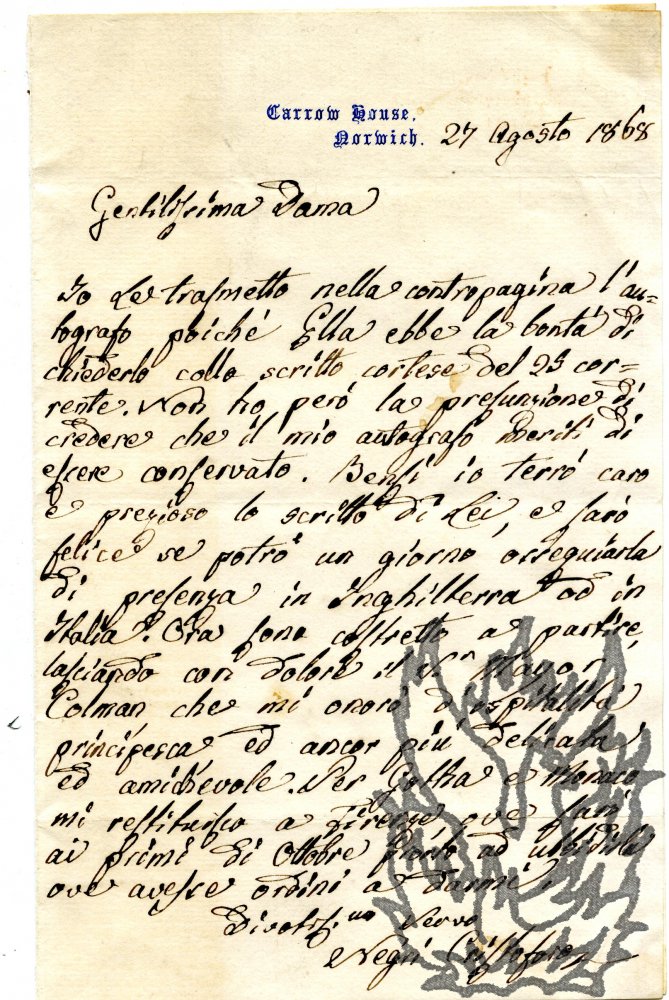
Autograph Letter Signed (twice, both 'Negri Cristoforo' ), with short poem, to an unnamed woman.

Author: 
Cristoforo Negri (1809-1896), Italian politician and first President (1867-1872) of the Italian Geographical Society [Jeremiah James Colman (1830-1898), Norwich mustard manufacturer]
Publication details: 
27 August 1868; on letterhead of Carrow House, Norwich.
£120.00

12mo, 2 pp. Bifolium. Fair, on aged paper with a little light staining. The recto carries the seventeen-line letter to a 'Gentilissima Dama', in response to a request for an autograph. On the reverse of the second leaf is a four-line poem, signed and dated by Negri, beginning 'Come un Nume che si adora'. In the letter Negri writes that he does not have 'la presunzione di credere che il mio autografo meriti di essere conservato'.

Syndicate content