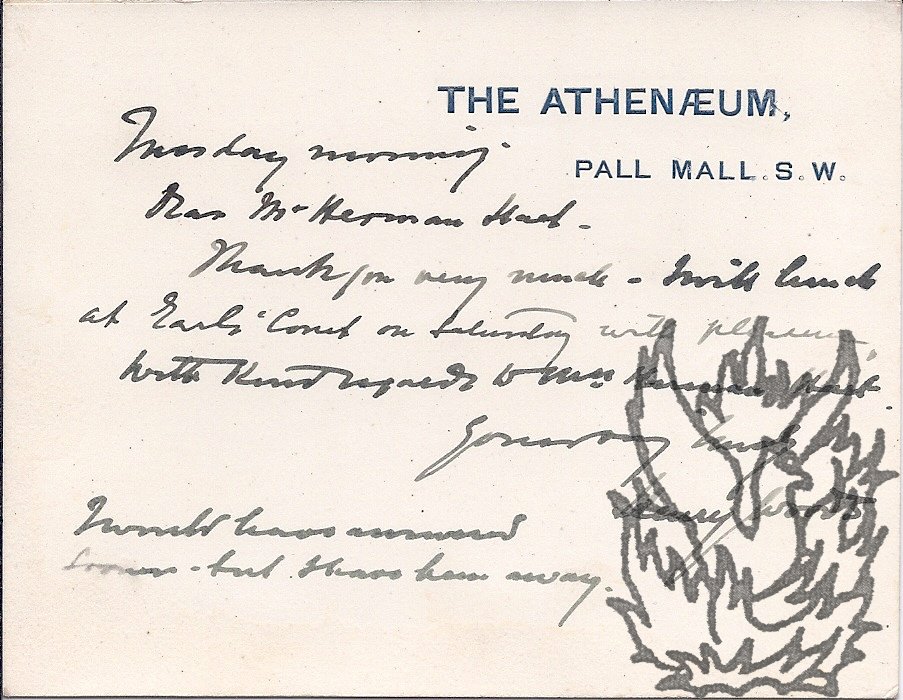
Statesman, father of Winston (1849-1895). One page, 8vo, good, saying that, although he agrees with a Bill, his official position will not allow him to put his name to it.
French composer. 2pp., 8vo, , referring to a list he has added to the letter of 8 pieces he would like to publish if his correspondent can cooperate. He has the proofs of To the Hills “a votre disposition”, and describes in a postscript a “fantaisie” he has justfinished.
Lord Houghton, poet and politician (1809-1885). 2pp., 8vo, damp-staining not obscuring text, inviting his correspondent and wife to the debate on the occupation of Cracow at the House of Commons, giving directions for a meeting afterwards.
Novelist (1861-1955). 3pp. ea., 8vo, good. He cannot accept Bill’s invitation because he has arranged to play in a cricket match. He has been accumulating material for a book on Brittany(“By ‘serious’, I mean not a novel!), and reports on the success of The Face of Clay (published 1906).
Writer (1849-1923). 1 & 2pp., 8vo, good. In the former, he gives details of his movements in the expectation of a meeting. In the latter, he describes his plans and, when he has been able to “get at” his copies of his book, he will send him one.2 items,
Politician (1786-1863). One page, 4to, good, , damp-staining but text clearsaying that he will “defer the Borough meeting” and hope to meet hiscorrespondent at the Budge Hotel.
Architect (1814-1895). 1 and 2pp., 8vo, good, discussing Murray’s specifications for the St Bride’s Foundation which, initially, he has to study. He eventually decides that, subject to minor changes, he will be able to recommend them. Christian was the architect for the National Portrait Gallery and architectto the Ecclesiastical Commission.2 items,
Irish author and editor (1800-1889). One page, 8vo, good. He is thanking his correspondent on behalf of his wife for his contributionof a “little picture . . . in aid of the governess asylum”.
2nd Earl Granville, statesman (1815-1891). One page, 8vo, small portion cut out (place name prob.), ow. good. He claims a prior engagement, presumably after receiving an invitation, and hopes Clarendon is not tired after a long journey.
Statesman and man of letters (1838-1928). 3pp., 8vo, good. He and his wife are pleased that their son is happy (presumably at aboarding school). He then expresses his detestation of the sort of touristwho does not enter into the spirit of a place (in this instance, Venice).
Judge (1796-1880). One page, 8vo, good. He asks for an opinion on whether someone could procure a patent on the basis of some papers he is sending to him.
British Museum ceramics expert. One page, 8vo, good. He passes comment on a blue and a yellow pot, dating them, and giving the countries of origin of the yellow pot.
Baron Taunton, statesman (1798-1869). 2pp., 4to, good. He has been sent some material relating to the Merchant Seamen’s Billand relates it to his own views on the matter.
Corsican-Russian diplomat (1764-1842). One page, 12m,, in French, some damage to one word, traces of mounting. He accepts an invitation in gracious terms.
French general (1815-1896). On visiting card, two sides, in French. He expresses regret at not being able to see or receive “Mr. Roumieu” inTouraine. He later describes himself as an old friend of England’s.
French politician (1755-1849). 2pp., 4to, sl. creased. In French with official stamp.He recommends to Persil’s attention a “M. Ducon”, lawyer and “sous-prefet”, describing his exemplary character and his achievements, and requesting an extension of his period in office.
Banker and writer (1840-1930). 2pp., 8vo, good. He is asking friends to his home for “chat and supper”, including Bowen.He gives minute directions how to get to his house in Tufnell Park.
Author and positivist (1831-1923). Printed item. Frederic Harrison, "The Herbert Spencer Lecture delivered at Oxford, March 9, 1905 , wraps, chipped, contents g., with a card attached to the titlepage, saying that the pamphlet is a gift and “cost me long study”, signed “F.H.”.
Painter (1842-1921). 2 ANSs, 8vo, good. In the first letter, he says that he has rested and feels able to continue with the sittings. In the second, he asks if he can exhibit her portrait at the “Grosvenor”. 2 items,
Canon of St Paul’s and wit (1771-1845). One page, 4to, good. some damage, slightly affecting the text, traces of mounting. Smith outlines his travel plans, including a visit to his correspondent. He continues, “We talk of nothing now but bombarding & it is supposed that Troy would have been under such a Cannonade have been taken in 15 or 20 minutes”.
Daughter of J.F.W. Herschel. Two pages, 8vo, good condition, still attached to part of page from album, expressing her regret at missing her visit and arranging a meeting.
Prince related to Victoria (DNB). Piece of paper, c.6 x 4", sl. soiled but clear, missing top left corner (and a word or two), text as follows: " . . . [end of word] 13123 / [P]lease give the Bearer 2 Gal: Brandy No. 2. at 24/6 the Gal: --- / Gleichen/ St James Palace / March 29/83/ The Secretary / A & N. Co:Op: Socty"
Moncrieff, Sir Alexander 1829-1906, colonel and engineer (DNB). Bold signature and date on part of headed notepaper (Royal United Service Institution), paper, c.4 x 4", slightly stained from having been laid down but clear.